
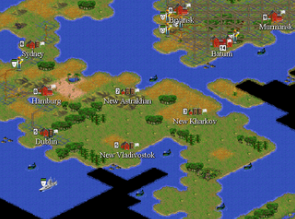
 Two days ago, a Redditor going by the name Lycerius posted the resultof his playing the same game of Civilization II for almost ten years. In his words,
“There are 3 remaining super nations in the year 3991 A.D, each competing for the scant resources left on the planet after dozens of nuclear wars have rendered vast swaths of the world uninhabitable wastelands.”
His description is powerful, ominous, and hilarious, which seems a perfect microcosm of Reddit itself. The first thing that popped into my head was the post artfully spliced together the key themes of my two favorite novels, 1984 and Foundation. 1984 for the three super nations locked in an eternal struggle, told from the point of view of a communist totalitarian state, and Foundation for the process of running a model of human behavior into the future. The next thing that hit me was that the social graph may very well be the key to bringing order to the galaxy.
The future of social lies in emotion, a concept that I wholeheartedly agree with. We talk a lot about this idea, and I’m glad he finally put his thesis to screen. When we get weird and esoteric like that, the thing I typically bring up is the idea that social and affinity networks present so much direct data, with increasing veracity, that behavioral patterns start to emerge, allowing you to predict human behavior. In Foundation, Isaac Asimov bases the theory of psychohistory on the motion of gases. Individual molecules act randomly, but the collective action may be predicted. In his prequel novels, he explored the challenge of human perception, charting how the biased source material of history could be reconciled with the cold mathematics of psychohistory. This was all before Facebook was invented, and I believe that had Asimov lived he may have used social networking as the solution to the psychohistory challenge.
Granted, computer modeling human behavior predates both Facebook and Civ II. In college, my IR 499 class used a declassified CIA program to model the behavior of nation states, based on the known inputs and outcomes of iconic international crises. However, it was hopelessly dependent on what inputs you provided. Similarly, the inputs of Civ II, while creating this awesomely arcane outcome, result in something that must be discarded as fiction due to the balance of the game design and the choices made by a single player. However, social networks have self-sustained, broad-based inputs. Like Wikipedia, nothing incorrect can survive for long, assuming that policing factors are in play. The trends emerging have more veracity than any single-input model of human behavior.

The question is, can we evolve social networks beyond the navel? We’re awfully pleased with ourselves, posting lots of wonderful pictures of ourselves, attributing huge value to our likes and dislikes, and reposting George Takei’s reposted thoughts. But we’re also arranging our events through Facebook, organizing revolutions through Twitter, and offering real-time feedback on the pronouncements of our leaders. We are achingly close to a true digital democracy, an illusion to the great thinkers of ancient Greece. Plato argued against democracy, and in favor of a republican form of government, since he felt that a just ruler could be upended by the masses if they were ill-informed. However, with more people actively sharing than just listening, it seems that the masses have less opportunity to enjoy being uneducated and ill-informed. Even people who don’t read or watch the news, get clips posted on their wall, and feel compelled to watch, internalize, and post.
Granted, we try to show the things that we hope present us in a strong light. But there’s all sorts of behavior that we surrender that we can’t possibly police all that much. The events we create and attend, the things we click on on our walls, the affinity groups we belong to. As social networks evolve, we will likely contribute more and more true information about ourselves, our choices, and our actions. This goes far beyond advertising and marketing, there is a real potential to derive increasingly accurate trends of behavior, that seem less like the fictional world from Lycerius’s adventures in Civ II and more like actual history. I would be very interested to see which models if denied inputs from last year on, come up with results that mirror today’s world.
Certainly any model of human behavior can be disrupted by an extraordinary individual, like the Mule from Foundation and Empire, or natural phenomena which are by definition outside our actions. However, the more we link up, the more we improve the model. While much science fiction has our computers becoming sentient and overthrowing us, or biomechanically incorporating us, we seem to be fueling something that leads us more to a meta-organism singularity with stronger data-driven predictability. Is this dehumanizing?