
 This article has lingered in draft form for weeks. For a blog that’s only a couple of months old, that’s a long time. I suppose I’ve been avoiding it. If I’m going to be honest with you, it’s because doing this subject justice requires me to share a little more of my personal life than I’m used to disclosing to the game industry at large. So, for those of you who prefer your SoMoFos writing to be free from cloying or awkward personal details, and prefer it to expertly pierce to the heart of key game industry and design trends, there are plenty of other suitable articles here to choose from. But before you click away, I’m realizing I haven’t even said what this article is about. I suppose I’m still stalling, but what I’m driving myself up to, is to describe my own long-term relationship with materialism.
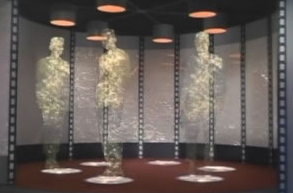
Beaming In
Like most people, I grew up craving stuff. I needed every Star Wars action figure. Getting every playset was slightly prohibitive, so I sated my collecting drive with the range of action figures. I then got into VHS, taping every single Star Trek episode off the air, and displaying them proudly. Games were always expensive, and risky, since there was no way to preview them, so I worked to get the few that I was sure I wanted. And of course there were books. My uncle gave me his reader copies of Foundation and Dune, and I was utterly spellbound. From that moment, I voraciously consumed science fiction, historical fiction, modern thrillers, science, psychology, history, and the extraordinary prose of the masterful George Orwell and Vladimir Nabokov. I read a book a week for a decade, and kept all of them, except the ones borrowed from a library. It’s from this rich soup that my first effort, Tearing the Sky, emerged. But something else hitched a ride too.
We are instructed by Madison Avenue that the things we own, the clothes we wear, the cars we drive, are each a direct personal expression of our character. But even more deeply rooted in Western Civilization, the clod of soil you own determines your standing in the body politic. Only the landed aristocracy could vote at first, and even to this day, the attribution of value to property ownership is enshrined in law school curricula. Property law is a required first year course, while Jurisprudence, or the philosophy of the law, is an optional third year class that only four people take. At the same time, we admire the Dalai Lama and his extremely unmaterialistic lifestyle. But this appreciation is often skin deep, we’ll like him on Facebook, quote him in our dating profiles, but rarely adopt his philosophy.
I’m not saying I’m there, mind you. I am indeed a homeowner. That part of the American Dream seems to continue to be firmly lodged in my psyche. But like Manifest Destiny, I’m seeing the costs associated with it. When we moved into this place, the movers were astonished by the sheer number and weight of boxes filled with books. It took twice as long as they expected, and the bill reflected it. And they lost my bronze samurai. Never use Shamrock Moving. But back on point, all told, there were 2,000 books that found homes in three large bookcases, shelves, and boxes in storage.
Then, slowly, something strange started to happen. I began to feel entombed by these malevolent bookcases, dividing up the master bedroom. Whether it was a concern about getting crushed by Frank Herbert and friends in an earthquake, or something more noble, I really can’t say. But in parallel I was noticing that my enjoyment of life was not proportionally increasing with acquisition of wealth or material. I would tentatively, perhaps naively, mention this to other people in the game industry, and they would politely titter. They would raise the issue of the cost of living in San Francisco, and all the obligations we fall into. But are these issues that we should allow to control the course of our short lives? Is land and a nice car a fit legacy?
Beaming Out
And slowly but surely, I began to dematerialize. First, I realized only about 400 books were that precious to me. So I eBayed or Goodwilled the rest. Same with DVDs, although that had as much to do with the Blu-Ray revolution. However, this time, the rebuilt collection isn’t a library of every movie I’ve ever liked, just the ones that bear repeat viewing. Certainly the digital convenience revolution played a role as well. But then things jumped into high gear. I got a divorce. And a lot of the stuff that surrounded me was gone in a day. When I stepped back into the home, I was surprised to feel myself breathing easier, with less stuff closing in on me, owning me. At the same time, I was losing weight, and none of my clothes fit anymore. So I got rid of them. All of them, but the clothes I was wearing that day. I shaved my goatee. I took bags of clothes out of the house, but also bags of other stuff as well. I depleted my closets and my storage locker in the garage. All of a sudden, the joy of taking things out of the house eclipsed the joy of taking things into the house. I no longer needed to hunt down that original prop phaser.
Some of you who have known me for a while may laugh at this. My home still has a bunch of cool stuff in it, and my chair at work usually has a pile of Amazon boxes on it if I’m away for a week. And it’s true. I’m not all the way through yet. There are some objects that I enjoy that have warm associations with them, or enable future ones, like high end photography equipment. And in general, being a tech geek requires a certain acceptance of planned obsolescence. However, even with the Amazon boxes, more things are still going out than going in. I rarely shop in the real world anymore, so unless it’s from Amazon or Whole Foods, or some occasional new clothes, I’m not buying things as much. I’m selling things on eBay and Craigslist, donating things, and lending art out. Perhaps once I disgorge or recirculate the majority of the stuff I’ve accumulated over the years, and distill to the essentials, I’ll hit an equilibrium point.
But materialism isn’t just about tangible goods, it’s also about consuming digital products. I canceled cable, largely due to issues with Comcast and a need to have time to run, but the result is that my thoughts are once again my own. I no longer seat myself to be lulled into a sitcom stupor. There are exceptions, such as finding a way to watch Game of Thrones, but for the most part I don’t miss it. My consumption and time dedicated to games and movies has gone down. The only thing that’s still up is my consumption of digital books. But I’m not sure there’s a downside there.